

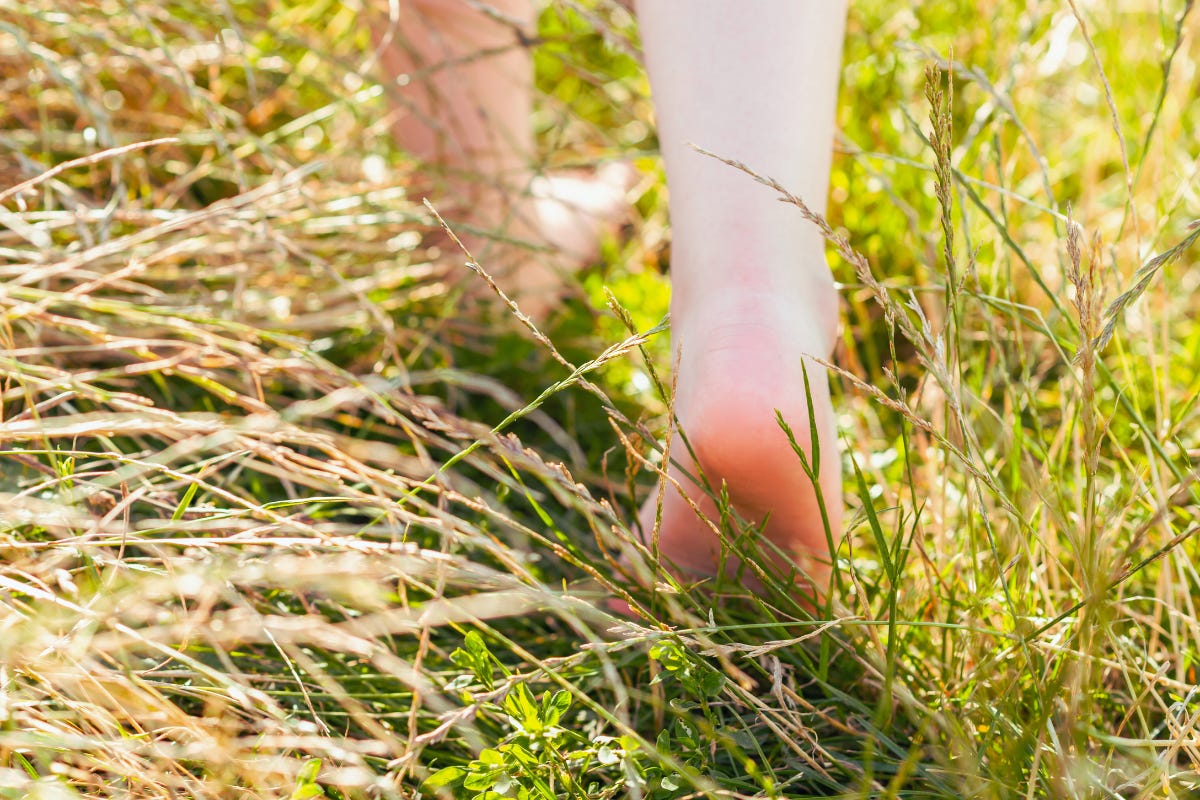
At the end of my dream of the Bird who Flew Free, I found myself improvising an entire song. The structure, the lyrics, the melody of the song were all fully formed, and tumbling out of me.
About six months later, it came to pass in real life.
I don't mean to suggest that the song I improvised was polished. It was raw and repetitive. You could say it was a bit wild, like a wrinkly newborn baby who landed wailing in my arms – fuelled by pure emotion and instinct. But even though I later added a bridge section (two actually), and tweaked some of the lyrics, it was already a complete entity on arrival, knowable in its nature.
Why am I choosing to share this story with you? Well, it's a story for anyone, like me, who has experienced a great sense of longing around the artist, vocalist, and songwriter they wish to grow into. And since you're here reading these words, I'm guessing you may have experienced a similar kind of artistic longing too.
The song I improvised, which I have since evolved and developed, is called 'Walking'. It describes a journey, and over the seven years since I first created it, it has taken me on a journey – one in which I've learned an invaluable lesson I simply didn't foresee.
My song ‘Walking’ has taken me on a journey – one in which I've learned an invaluable lesson I simply didn't foresee.
Before I dive into the story, let's talk about the longing – why it's there, and what it's asking of us.
What acorns and oak trees can teach us about being human
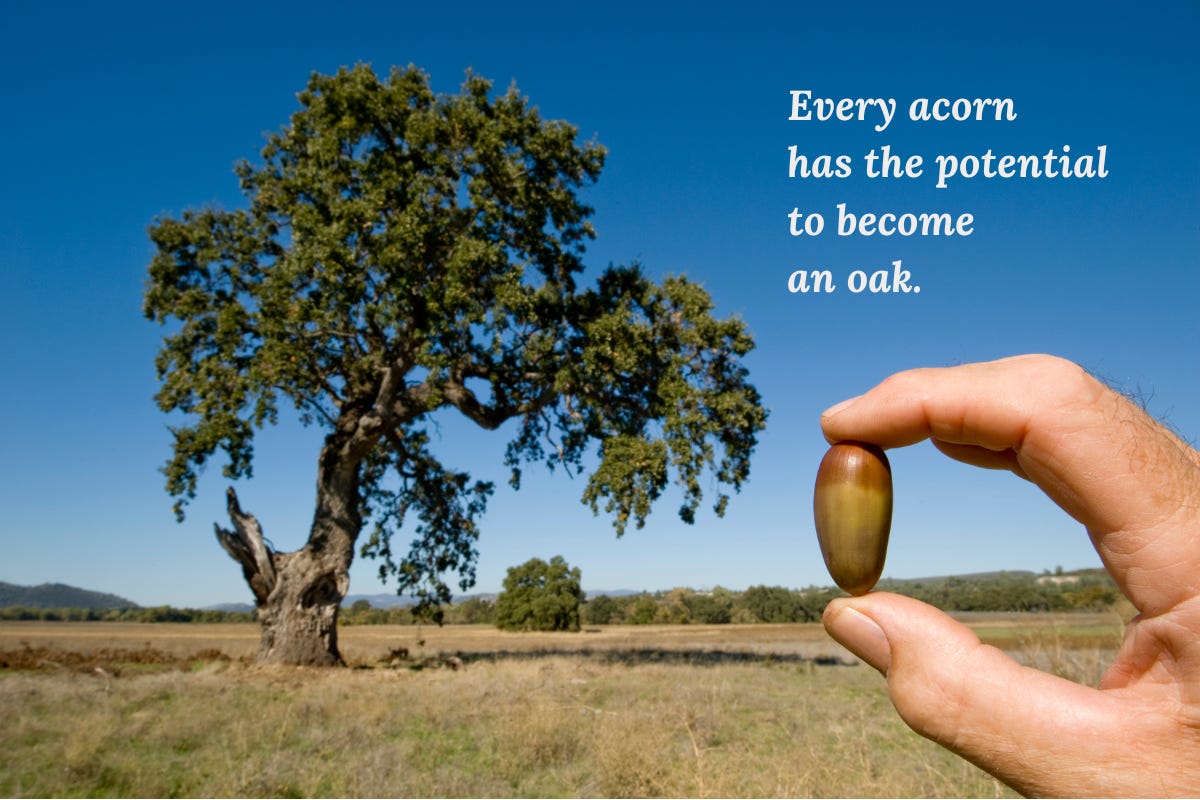
I once saw the activist Satish Kumar give a talk at an environmental festival (Seed Festival in Stroud). He likened human beings to acorns, with the potential to grow into oak trees. Just as an acorn contains all the intelligence needed to evolve and grow into an oak, I believe, like Satish, that all of us possess a knowing of the person we would become if only our spirit, soul, DNA could be given the conditions they need to be fully expressed.
It's just that there are many, many forces, barriers, drains on our being that are blocking that inner knowing and its fulfilment.
And what reconnects us with this inner intelligence? I believe it's our emotions.
Follow that feeling!
The feeling of longing for something is for me a sign with an arrow saying, ‘this way please!’ When it arises from the core of you, and it's deeply felt, I believe it's an indicator of your potential to bloom by following a particular path. So if you've felt a longing to write songs, perform them, develop skills as a piano player, or whatever it might be, I believe you'd do well to listen to it. It can be trusted – more than any opposing voices in your head, exterior opinions, or outside 'evidence' that seem to suggest something different.
I felt an artistic longing around my voice and creativity. I didn't see the possibility of prioritising it for a long while, but eventually I figured out how to follow it. Here's a little piece of what happened when I did.
The birth of a song
I was ten months into Briony Greenhill's vocal improvisation course Wild Voice Solid Roots, and we'd just spent an entire weekend immersed in the theory and sound of the natural minor scale. We'd woven the scale into improvisation after improvisation together – we were practically vibrating with it.
As an aside, I want to acknowledge that there may be singers reading this who don't know the natural minor scale, who don't even know what a scale is. I'm mentioning it because not knowing what I'm talking about could possibly be triggering some uncomfortable feelings – of exclusion or feeling less-than. Just please know that in my world, explicitly knowing music theory is not the same thing as understanding music. It is a way to make sense of music, and it can support you to write songs for sure, but it's not actually essential. I'll have more to say on this in the future.
For now, it's enough to know that a scale is a set pattern of notes that go up and come down again. If you take the selection of notes that the scale gives you, and mix them up to make a melody, they have a distinctive 'flavour'. The natural minor flavour is generally considered to sound sad or poignant.
The very next day after my minor-scale intensive weekend, I'd arranged to go round to my friend Julie's house. She had an acoustic piano (something I didn't have, and still don't have – yet!) I was using a keyboard to support my daily vocal improvisation practice, but as a treat Julie said I could use her piano. I was looking forward to soaking up its rich resonance, and all the inspiration that comes with that.
When I arrived, Julie said, "I need to pop out to the local shops to pick up some groceries. I won't be out for too long".
I was left alone in the house, just me and the piano.
"Right", I thought. Julie's house was only three minute's walk from Gloucester Road and all its independent shops (said to be the longest stretch of independent shops in Europe). It wasn't going to take her long to reach said shops, so I probably didn't have that long to practise on her piano in private.
I had fire in my belly that day. I was focused. “I want to make something happen here”, I thought. “I want to improvise a song”.
Creativity loves limitations
I couldn't do much in the way of playing the piano back then. I'd had a few lessons when I was a child of five, and later at seven. The family home I grew up in was quite small; there was no room for a proper piano, and at that time keyboards lacked touch-sensitive keys. They were not any kind of substitute. As there was no way for me to practise, I didn't carry on with my piano lessons.
However, I could still remember where all the notes were on the piano keyboard. I also knew how to make the most basic kind of three-note chords by selecting notes from the natural minor scale. And finally, I knew that if I used only the white notes on the piano, keeping 'A' as my 'home note', I'd be in the key of A minor.
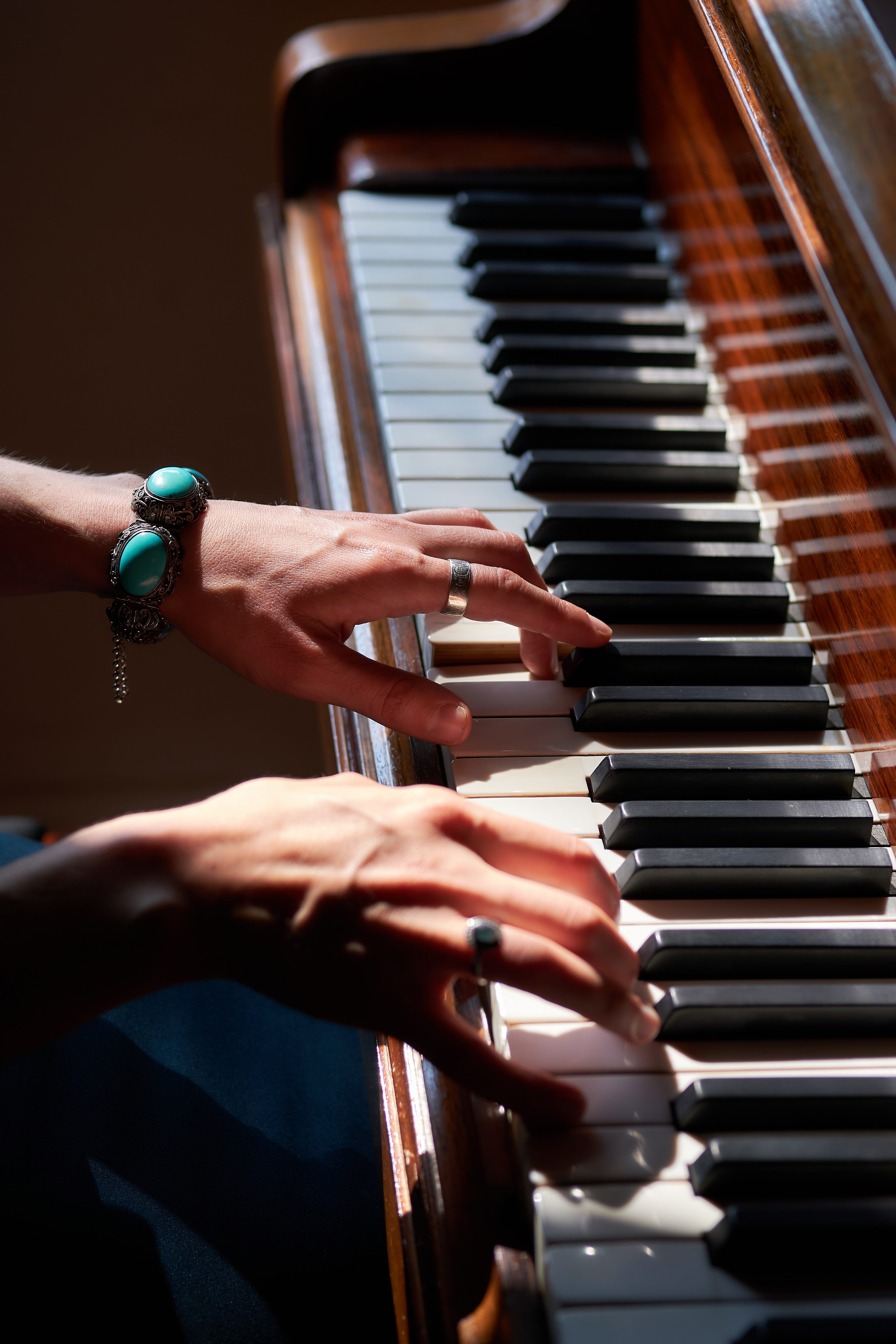
They say that creativity enjoys limits, and this was a perfect example. I had my limited tools – the natural minor scale, the white notes on the piano, and three-note chords (triads). Quick as you like, I found a sequence of four chords I liked the sound of, and which I could keep looping. Bingo!
I hit record on the voice recorder on my phone and started to tap out an intro using mainly the three notes of the chord of A minor. I was fully in it – you can even hear on the recording how my breathing was synching up with the piano rhythm, even before I started to sing.
Enter the longing
I suddenly felt frustration jab me in the ribs. My piano playing was so basic. "I'm just plodding along here," I thought. "I'm plodding over these keys and I want to run! I want to fly! I want my voice to fly and my fingers to fly and that's how I want to express myself! And I'm so so far from all of that."
Ohhhhh, the longing!
In that moment, there it was: the song. It fell out of me as a calm, measured response to all this longing and frustration – as if my Higher Self was now taking the reins. I took a breath, and over the steady groove of my fingers pacing over the keys, I started to sing:
"I'm walking, I'm walking, I'm walking, and it's OK."
The song fell out of me as a calm, measured response to all this longing and frustration – as if my Higher Self was now taking the reins.
I was accepting exactly where I was in that moment: the baby steps, the slow and steady pace I was taking over the piano keyboard. Referencing the fable of the Hare and the Tortoise, I found myself affirming to myself that "steady walking will get you up the hill". At the same time, I recalled a dream I'd had about two weeks prior where I'd been standing on a cliff top looking into a scene of the most vivid-imaginable turquoise ocean, with golden sandstone arches in the far distance. In this dream I'd been gazing on the arches and repeating over and over to myself, "I need to go there, I need to go there, I need to go there!" And I was also remembering the Zen wisdom that I'd read in a book about 17 years before, that 'travelling is more important than arriving'.
It was all happening in real time, in an unbroken stream of melody and lyrics.
As I sang, "I'm walking", I was also metaphorically putting one foot in front of the other until the improvisation was complete.
And it was all captured in a recording. Here's a part of it:
What's up with my voice?
You might notice that in the recording I'm singing with a slight North American accent, which isn't something I usually do. I’m really curious as to why this is, as it wasn't something I consciously decided on. I obviously had a very clear idea of the vibe I wanted to create, and it’s as if I’m referencing a genre or tradition that’s known to me.
As I write this, I'm remembering that I once did some reading online about the history of African-American music, including the work songs that developed during the era of slavery in the USA. I know that the rhythms of the songs synchonised with the movement patterns of labour. That’s what I was imagining as I improvised Walking: that as I was creating the rhythm, slow and laboured footfalls were happening in sync.
The really strange thing is that even though I know work songs exist, I don’t actually know any! I also don’t know when I first stumbled on the concept of a work song – it might have been since I improvised Walking. It all feels quite mysterious.
Manifest-sing
At the time I improvised 'Walking', my aspiration was to have the freedom to express myself in a way that was as big and expansive as the possibilities that were already alive in my imagination. Almost seven years on from the original improvisation, I've achieved this to a great extent. My skill at playing the piano and my vocal technique have both really evolved as a result of my consistently showing up to learn, train and create music. (Honestly, it's felt one-hundred per cent a pleasure, and never a chore.)
I took what I'd improvised and developed Walking as a song. The piano arrangement – which I finally completed in January 2025, six years after Walking was born! – is now very varied. I've also been able to add a long vocal run at the end, and make use of the higher notes that I can now access in my vocal range. Here’s a video of me playing part of the song last week:
The lesson I never expected
So my dear reader, I thought this post would end here. I set out to tell a story about artistic longing, the value of following it, and the possibility of realising your aspiration. But in writing this story, I've returned to listening to that original improvisation – the recording I made on my iPhone at Julie's house, when I could barely play the piano. And, there's something I need to acknowledge about it, which I simply can't deny:
It's just so arresting.
I find it achingly beautiful. (My goodness, it's hard to say that out loud about my own creation, but that's the truth of how I experience it!)
In fact, I much prefer listening to my original improvisation than to any of the recordings I've made recently of the more evolved song.
So what does that mean exactly? Where does that leave us?
The moral of the story
When I realised that I loved my original improvisation of Walking more, it put me into a spin. Had I just wasted countless hours over a period of years to develop a song I didn't like as much as the raw creation?
Once I'd calmed down about it, I decided to get curious. Actually, this was fascinating. I'd sung an improvisation about how much I was yearning for skill and agility in my voice and on the piano, yet once I'd manifested the skill and applied it to the same musical idea, I found myself preferring my original!
I'm still in a process of enquiry about all of this. However, after chewing it over with my piano coach, Claire Housego (who knows all my songs inside out), this is where I've got to with my thinking:
The emotion and meaning of Walking were truly alive in me when I did the original improvisation, and that energy is a large part of what gives it its power.
The slowness, steadiness and simplicity of the piano perfectly express the meaning of the improvisation.
There's a vulnerability in the original that has been lost as I've become a more accomplished musician, and more focused on my technique as I play the song.
So in conclusion, even as I was longing to be a more accomplished artist, I was already capable of delivering a beautiful, powerful, and moving performance.
Even as I was longing to be a more accomplished artist, I was already capable of delivering a beautiful, powerful, and moving performance.
I have no regrets whatsoever about the journey I've been on with this song. I truly love the freedom of expression I've gained as a more skilled piano player, and I feel a strong affection for my current piano arrangement of Walking. However, I feel that there's an invitation for me within the story I've just told. That is, to loosen my focus on technique when I make music, and refocus on meaning and emotion. For me, this is what brings music alive and creates the connection – between me, the song, and anyone who's listening to it.
Perhaps I will play with different arrangements for Walking, some of which could return it to its original simplicity, or incorporate improvisation on the piano. I’m reminded of the sheer power of vocal improvisation as a practice, and I definitely want to bring it back as a bigger focus in my daily music-making.
For me, the moral of the tale is this: do follow your longing – it will bring you so much joy, fulfilment and insight. However, as you walk that path of development, never underestimate the power of what you already bring.
We must resist believing that we can only shine as artists once we reach our desired musical destination. The essence of your artistic nature is already in you, and always has been. So, in the words of my song:
Enjoy the ride, walk with pride, and own your stride!
(And, if you'd like to hear the whole of Walking, you'll have to catch me at a live performance – or wait until I can get it professionally recorded. Watch this space!)
I enjoyed being there with you during this story. Personally, I love both versions of "Walking"...but I can definitely FEEL something more raw in your earliest version and it resonated within me. It felt familiar, ancestral. In fact, it stirs up some of the same energy I feel while singing "The Gayatri Mantra".